Friday, August 30, 2013

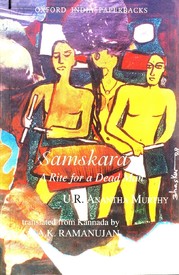
Samskara by U R Ananathamurthy, Oxford Paperbacks


U R Ananthamurthy’s Samskara was written in the 1960s and I am thankful to my friend for suggesting that I should read it. Originally written in Kannada the English translation is a very good read. The story is quite famous and has been made into a film also. The story revolves around the  death of a Brahmin man  and the confusion around the performance of his last rites .The man  is considered a heretic by the village Brahmins and was shunned by his community when he was alive , yet his last rites cannot be performed by  any non-Brahmin  according to social rules. Life in the tradition ridden village society is wonderfully portrayed and  the conflicts amongst castes, the various social taboos have been narrated in great detail.

What I enjoyed reading most was the close analysis of the psychological conflict waging in the mind of the revered Brahmin pundit  . Pranesacharya the central protagonist is faced with a life changing situation which completely destroys his peace of mind but in a way it also liberates him from the fetters of tradition. He tries to escape from his known surroundings initially but later on longs to return to his village and among his fraternity. A celibate who shuns all kind of vices and  weaknesses , who deliberately marries a sick woman and seeks spiritual release by serving her unfailingly, has a chance encounter with a low-caste beautiful woman . The ancient texts which he knew by heart and used to recite everyday suddenly come to life as he experiences reality in the shape of this beautiful woman. He feels he is not a Brahmin anymore but does not repent it.
The social situation might seem dated for urban tastes but anyone who has been brought up in  conservative brahminical traditions cannot fail to notice the striking resemblance to one’s own emotional, cultural and social response to similar situations in life.  Samskara can have a vice like grip on society and sometimes can destroy human lives completely. Pranesacharya reminded me about Tagore’s Gora. Both rediscover themselves  .


Monday, August 5, 2013

Garden of Evening Mists by Tan Twan Eng, Myrmidon books 2012

After ages I have read something so hauntingly beautiful , so mystical, so romantic and yet so sad. I simply raced through the pages of this lovely historical novel only to be left completely mesmerised by the magic of Twan's narrative .
The story is told in flashback. Yun Ling is a retired judge battling the onset of dementia .Before her mind fails her she wants to capture her memories in words.
Below is a quote from http://www.tantwaneng.com/
"On a mountain above the clouds, in the central highlands of Malaya lived the man who had been the gardener of the Emperor of Japan.”
Teoh Yun Ling was seventeen years old when she first heard about him, but a war would come, and a decade would pass before she travels up to the Garden of Evening Mists to see him, in 1951. A survivor of a brutal Japanese camp, she has spent the last few years helping to prosecute Japanese war criminals. Despite her hatred of the Japanese, she asks the gardener, Nakamura Aritomo, to create a memorial garden for her sister who died in the camp. He refuses, but agrees to accept Yun Ling as his apprentice ‘until the monsoon’ so she can design a garden herself.
Staying at the home of Magnus Pretorius, the owner of Majuba Tea Estate and a veteran of the Boer War, Yun Ling begins working in the Garden of Evening Mists. But outside in the surrounding jungles another war is raging. The Malayan Emergency is entering its darkest days, the communist-terrorists murdering planters and miners and their families, seeking to take over the country by any means, while the Malayan nationalists are fighting for independence from centuries of British colonial rule."
For Aritomo creating the garden  is almost like being on a spiritual journey. As his disciple and later his lover Yun Ling becomes part of this spiritual quest. There are lot of cultural similarities with India which I could relate to .The descriptions of the workers' lives in the tea gardens, the atrocities carried out inside the camps and the exploitation of women who are treated as commodities and slaves, the lifelong love and friendship of  two adults who could have married yet both chose to remain single, the almost spiritual personal love story of two human beings belonging to enemy camps in the public eye, how an adopted country and its people can mean  so much to someone that you end up by paying with your life  and above all the beautiful descriptions of the Malayan landscape - all contribute towards making this novel intensely likeable.The book has intimate details of the Japanese tattoo art form, which is quite fascinating to read.
Twan's language is beautiful , almost philosophical at times. The language is languid and slow at times and at times open to interpretation because of the philosophy behind the words.This is a must read for all . 

Tuesday, April 2, 2013

In the falling snow/ Caryl Phillips, Harvill Secker 2009

 Caryl Phillips is one of my favourite authors. As usual he writes beautifully and deeply .

The book is about an individual’s search for identity in a modern multi-cultural world. Keith is a black man married to a white woman and they have a son. His one act of infidelity damages his carefully nurtured relationship with his long time sweetheart, university mate and wife Annabelle. Keith starts living away from his family and gets involved with his office colleague who is a divorcee. When he tries to withdraw himself from this relationship he is charged with sexual harassment by his young colleague who feels she has been used by him. Meanwhile Annabelle finds it trying to handle her son who is at a difficult stage in life and seeks Keith’s help to sort out matters .Though Annabelle and Keith have great mental bonding the book does not talk about their reunification . On the other hand the characters all live as isolated individuals trying to chalk out their own existence in this world.
The book also deals with old age problems. Keith and Annabelle both have to deal with aging parents. Keith’s sick father stays all by himself .He refuses to go and live in institutions where his other friends stay. He talks about the betrayals, disappointments, sufferings that he and his other friends had to suffer as black men in a predominantly white society. Annabelle’s father on the other hand is ashamed of his black son in law and never really accepts him as one of their own.
Keith’s son Laurie is again a victim of various racial prejudices. His white mother feels his black father can understand him better and protect him from trouble. However what Keith experiences when he meets his estranged son goes beyond mere racial problems .It becomes more of a psychological problem which is universal in nature.
 “Of course he wants his son to talk to him, but he understands why his son feels a little distant. Sons can be unforgiving towards those who they believe have hurt their mothers. “

While racial and social issues form the overriding theme of this book the story also depicts the impatience of modern man. Keith has no real feelings for the women he beds casually, Annabelle is deeply concerned about her family’s well being and hates to find Keith in a sorry state ,yet the two cannot find the words which could have saved their love and lives .
A lovely book which leaves you thinking about possibilities.

Ref : Image
http://www.tower.com/in-falling-snow-caryl-phillips-paperback/wapi/114299487

Monday, February 18, 2013

The Dhammapada /Translation and commentary in Hindi by Dr Wangchuk Dorjee Negi ,Director of Central Institute of Buddhist Studies,Leh , Translated from Hindi to Bengali by Ramkrishna Das. Paraspathar Prakashan.2012


It is always a pleasure to discover new books from displays put up by small publishers at major bookfairs. . While picking up this book at the Kolkata Bookfair this year , I was more attracted by the cover design and yes of course the title of the book . However I was expecting this to be another complex , esoteric,difficult to understand –kind of book . But I was in for a pleasant surprise. Parashpathar Prakashan has done a wonderful job by bringing out a Bengali translation of Dr Negi’s work on the Dhammapada . Reading this much revered spiritual text of Buddhism in Bengali was a wonderful experience. Mr. Das’s translation is lucid and extremely easy to read. For ordinary human beings trying to make sense of the chaos around him a book like this can provide some direction to his confused inner world .

Dalai Lama in his foreword says ‘The Dhammapada is a handbook of practical ethics, that may be of interest or benefit , whether you are a Buddhist or not. …a disciplined mind leads to happiness and an undisciplined mind leads to suffering. The Dhammapada describes a path of ethical behaviour that is a feature of this kind of inner discipline that leads to happier life.'

The Dhammapada is a collection of Buddha's sayings in verse form . The language is Pali /Prakrit which has its roots in Sanskrit. It is believed that the each verse is related to a specific situation in Buddha's life and times . Dr Negi’s original book in Hindi was published and distributed free to people at large. Mr. Das was one such recipient who sought permission to translate Dr Negi’s edition into Bengali. I can only thank him for doing so . Each verse is followed by a brief story  and a simple commentary. Most of us are familiar with some of the stories linked to Buddha’s teachings to his followers. One of my favourites is that of the lady named Kisagotami who lost her son and roamed around grief stricken with her dead son's body . Someone took her to Buddha and she asked him to bring her dead son back to  life. Buddha agreed to do so only if she could fetch him a handful of mustard seeds from a family that has not known death. The book is full of such fascinating stories. The book can be read if not for anything else then just for its easy to understand collection of stories which illustrate the eternal truths of life.

While reading the book I once again rediscovered some of the stories which have lived with me from my schooldays. Today when I am re- reading them it is a different experience since life’s sufferings, setbacks, betrayals and moments of joy and happiness have already coloured my perceptions of life. While I can agree with most of the concepts some can appear alien in today’s context. What I feel Dr Negi has been able to achieve is to provide a commentary on the concepts in a manner suitable for contemporary readers. The Bengali translation is equally good to hold the attention of ordinary readers like me.


Saturday, December 8, 2012

Full Circle: How the classical world came back to us , by Ferdinand Mount , Schimon and Schuster 2010,p 438


Since most human beings are fascinated by the past and are curious to know more about the bygone era, the title of the book is tempting enough to attract a sizeable no of occasional readers like me as well as serious researchers on the subject. As you leaf through the book, Ferdinand Mount does not disappoint you.


‘So much about contemporary society bears an astonishing resemblance to the most prominent features of the classical world, the ways in which we live our rich and varied lives correspond almost eerily to the ways in which the Greeks and Romans lived theirs.. This is not a conscious imitation but has arisen naturally.’ By us the author means people in Britain and more generally in Europe and North America. The book argues that after 2000 years of sailing western society is now back at the jetty it embarked from. Though the book basically talks about western situations, in a globalised world it is not difficult to trace similarities with any urban society for that matter.

The author looks at different aspects of life and society and draws insightful similarities between the present and the classical past. .The book is divided into two main sections - Body and Mind. The chapters under Body are : the bath , the gym, the bedroom and the kitchen .Under Mind the sections are : Science ,Religion, New Age , Dialogue, Fame ,Art ,Nature , Scipio’s Dream.

The opening chapter talks about the Roman baths and the tradition of public bathing. Public baths sometimes known as Turkish baths were built in Britain and by late nineteenth century many cities boasted multiple bathing joints. These baths were extremely popular amongst all classes. Every rising industrial centre was proud of its baths.

In the chapter on Kitchen the author comments “ today an articulate concern with food and drink is the mark of a civilized person. A person who knows about food is regarded as knowing much more about life. Food writers have multiplied and there is a food column in every newspaper. In the Greek world Sicilians were gourmets and gourmands. Socrates commends “these refinements of Sicilian cookery for which the tables of Syracuse are famous”. By natural progression Sicily also bred the first cookery writers around fifth or fourth century BC. Most of theses works have perished with the exception of some like “gastronomia by Archestrus”.However the writer observes- the paradox is “Despite this torrent of advice on how to cook , the shelves of fat cookbooks in the bookshops and the huge fortunes piled up by cookery writers – in the shape of Delia Smith, enough to buy Norwich City football club- it is unlikely that people are in fact cooking at home more than they used to. Indeed if you look at the rows of restaurants springing up along every street, credit crunch notwithstanding , people must be eating in a good deal less and eating out a lot more.”

How true. It reminded me of a discussion I recently had with the proprietor of one of Kolkata’s oldest bookshops, who was lamenting the general decline of readership of good books and the popularity of cookbooks amongst fashionable urban ladies who made rare entries into their kitchens. An elderly lady who had spent long hours of her life in dark kitchens once remarked that today’s housewives have custom fitted modular kitchens but only for the benefit of their maid –cum-cooks .

In the chapter on Nature the author writes “The Climate change campaign (and the occasional ruthlessness of it s tactics) is as much a symptom as a cause of deeper and longer established impulse : the urge to re-earth ourselves.
There is a new Goddess to be worshipped : Gaia , the old earth goddess but now dressed in the robes of modern science. “ In Greek mythology “ Gaia is the source. She is mother Earth ,”Terra Mater” “ the alpha and omega of life. There has been a startling growth in the strength and number of organizations devoted to protecting the” environment” or the skin of Gaia. With the great carbon panic cheque books and credit cards are not enough. Everyone has to do a bit for the environment- discarding plastic bags, recycling waste ,slashing air miles, walking and cycling instead of motoring to work and what not. We all need to touch Gaia. Climate change deniers have been compared to Holocaust deniers. Some of the few sceptics have been denied research funds and their opportunities for promotion or employment blocked.

The book is full of fascinating details. President Reagan consulted astrologers and his favourite was Joan Quigley who drew a horoscope of Gorbachev before the two leaders met . A survey showed that 48% of Wall Street stockholders used horoscopes when deciding what to buy or sell.
The first account of some one reading without moving his lips can be dated to AD383 when St Augustine met Ambrose, the Bishop of Milan reading silently in his cell. In his Confessions St. Augustine describes this experience. Democritus lived to the age of 100 and was known as ‘Sophia” – Brains. He was the laughing philosopher and wrote an essay on cheerfulness.” In the Loeb Classical library where Greek texts faced English translations, the English right –hand page would switch to Latin when the text reached an indecent passage.”

The Financial Times recommends this as a good holiday companion. I would like to agree but only if you are holidaying alone on your own.


Ref : Image above "booktopia.com.au"


Sunday, October 28, 2012

A great poet and a great writer.


Our beloved poet is no more. A poet does not die .Long live the poet. Yet a vacuum is created in many lives. It is a personal loss for me. I never met him yet he was no stranger to me. I had grown up with him and lived with him through his thoughts and ideas till this day -my middle age, and hopefully will live with him till I die. Our poet was not just a poet . He had spread himself in novels, short stories , weekly columns , essays . I will miss his weekly write-up in ABP . Reading him was like being in conversation with him. As if he was speaking to you . I will miss his warm presence at bookfairs , on various city forums , in television coverages, his opinions , his speeches. The poet was our own. You knew him even if you had never met him personally. My dad and I were great fans of his travel writings. He could make such writing so lively by simple observations and by his great fluid style.

Newspaper reports tell that there has been a huge demand for the poet’s works since he died. I have also been trying to beat my sorrow by going back to his poetry.


We grew up with Nillohit in our youth and every festival number from the ABP group was eagerly awaited by idle dreamers like me. Nillohit captivated us. Those were the heydays of Desh the dominant ABP weekly magazine . For years we were equally mesmerised by his mega historical novels serialised in Desh magazine. We were hooked, not a single issue could be missed ,to be discussed and debated thereafter.
“ Shei Somoy”(Those Days) and “Prothom Alo”(First Light) both are classics in their own rights and have been translated . Both these works opened up a new world - a world untrodden for ages -to thousands of readers like me. We became his diehard admirers forever. He was a guru to a generation of poets and writers . I personally like him for the simplicity of his language both in poetry and prose. It is not always easy to understand poetry . However even ordinary readers like me could appreciate and enjoy his poetry . Such was the beauty of his writing.

Let the world be blessed with more poets like him.


Ref/ Acknowledgements:

Tuesday, October 23, 2012

Ban this book : What to read and what not to read that is the question

Talibans exist everywhere , they exist in people’s mind.The Malala incident is an eye opener and once again reinforces the power of the written word. Pen is mightier than the sword . Who would have thought that an innocent children’s book could create such a storm – a storm in the tea cup rather . The book in question is Timothy Knapman’s “ My adventure island” . A young father had borrowed the book from the library for his five year old son . The child had asked questions which you would expect any normal child to do. Now the over zealous parents had analysed the questions and come to the conclusion that the book was most unsuitable for their child. Next came the demand, placed to the shocked library authorities – remove the book from the collection.

I was compelled to read the book by public demand and I loved it. The book is part of this year’s Reading Challenge programme which is an annual reading event specially designed for children organised by the Reading Mission, UK. Every year there is a new theme and this year’s theme is Story Lab .Well the book is a fun book with lovely illustrations and a sweet message at the end. A little boy imagines doing all those naughty things in an imaginary island which he is otherwise forbidden to do – such as picking his nose, eating unhealthy stuff ,playing all day, not washing and living with a stink etc etc. Now how could these simple fun ideas influence and corrupt a child’s mind I had no clue. Fortunately I discovered that not all parents thought alike. Why have a censorship board at home – remarked another parent to my big relief. Another parent wrote on my FB status “The writers perhaps never realised in their wildest dreams that their material could cause such a flutter and debate among a certain class of readers who were never meant to read this book in the first place”.

Another lovely book which I could not resist reading was Neil Gaiman’s “The day I swapped my dad for two gold fish”. Dave Mckean’s brilliant illustrations make the book magical. The book reminded me of a Russian book which we used to treasure in our childhood days “When daddy was a little boy”. Gaiman’s note at the end of the book is equally fascinating. The book was conceived after a real life situation which Gaiman faced when his son was a small boy.

The story is about two children who swap their dad for two gold fish and then are sent by their mom to bring him back. While doing so they discover that their dad has changed hand several times and this sets them on a journey through different adventures. A remarkable book very lively and again full of fantasy and romance.

I have always been a big fan of British designers and specially book designers and illustrators. Books themselves are so colourful that you do not require any additional props when you are planning a thematic display in a public space. This simple display (pic )speaks for itself. I plan to read some more books from the Story Lab collection.

Ref:


Thursday, August 16, 2012

The Gathering by Anne Enright, Jonathan Cape

Anne Enright’s The Gathering is not an easy read. At least that is the way I felt .I had to struggle with the book. The language is fine for a non-native reader. It is the way the thoughts are presented and the manner in which the story progresses if at all you can call it a story .It is more of a narrative. Why did I choose to read it any way? Simply because I wanted to find out more about the book which pipped “Mister Pip” to win the Booker in 2007.Well I frankly did not understand why it did .The only reason could be the book is more complex and written somewhat in a stream of consciousness style . The book will appeal to a more sophisticated reader.


The story is set in Ireland and tells the story of the Hegarty clan. The father a staunch Catholic does not adopt birth control measures and sires many offsprings .The mother goes through several miscarriages and finally nine children survive .The story revolves round Eliza and her grief at the death of her beloved bohemian brother Liam. Liam’s tragedy is traced back to his abuse at the hands of a sick old man during his visit to his grandparents’ house as a small boy. Their grandfather Charlie lost his house to this man who was his friend and who lusted after his wife, in a bout of gambling.Charlie was a habitual gambler and always in love with his wife. Exploited psychologically and physically Liam grows up with a fractured mind and eventually commits suicide by drowning himself in the sea.

It is a family epic, a tale about the life and times of almost four generations in a family .Eliza tells the story of her grandmother Ada and her husband, her parents, her own life and Liam’s life and briefly touches the lives of her children Rebecca and Emily. The strength and depth of the brother sister bonding comes forcefully across. All other relationships seem momentary and based on sexual transactions with no real meaning or understanding between two individuals. Life is seen and interpreted through the experiences and perceptions of the central character in the novel. At times trying to piece the different elements of the story together becomes a bit confusing.

I enjoyed moments like these. Liam tells his father you are a f…..ing baboon . “ A drinker does not exist .Whatever they say , it is just the drink talking." “We pity our mothers what they had to put up with ,in bed or in the kitchen and we hate them or worship them but we always cry for them….” .“ Or once , I remember some afternoon when he sat at the end of the bed in the white curtains’ light, and he looked like someone I knew from the beginning , whenever the beginning might have been. "

Ref:


http://www.amazon.com/gp/customer-media/product-gallery/0802170390/ref=cm_ciu_pdp_images_0?ie=UTF8&index=0&isremote=0


Wednesday, August 8, 2012

Mister Pip by Llyod Jones


I  first heard about the book from a Scottish trainer who was then working as a consultant for the local government . I had forgotten about it though I knew it was available in the library. However when a senior professor of English left the book  on my desk with a recommendation  last week ,I took it home with me that very day. I loved the story . Mister Pip is a magical story full of romance, mystery, suspense, surprises and above all a story of love,faith and hope. Written in simple language it is a powerful story with lot of subtle nuances.

The story of Mister Pip is set in Bougainville an island in Papua New Guinea during the period when the island was rocked by civil wars . Mr Watts the only white man left in that village decides to educate the island’s small children who are left with nothing. Mr Watts or Pop Eye has a black wife Grace whom he carries around in a trolley . Nobody knows anything about him .Yet Mr Watts becomes a teacher who lovingly teaches the children to imagine a life beyond their humble surroundings . He uses the story of Pip in Dickens’ Great Expectations in his own style and inspires the kids to think and dream . The book tells the story of Matilda  who grows up to  become a scholar and an expert on Dickens. When Mr Watts is murdered and Matilda’s mother is raped and gives up her life to protect her daughter from being raped  by the rebels, Matilda  loses the will to live. It is Pip’s story that indirectly saves her and revives her faith in life .Eventually Matilda moves to Australia and is reunited with her father . She traces bits of Pop Eye’s past life which had  been kept as a secret from the islanders . ‘Mister Pip’ celebrates the wonderful emotion of love in so many ways -Pop Eye’s love for the black woman uproots him from his known white  surroundings and forces him to live a life in  exile , Matilda’s mother gives up her life to save her daughter’s honour and life , Matilda’s father plans to celebrate her birthdays with cakes for each year that he has lived away from her . The book narrates the  extreme poverty of an isolated  community in the throes of war , the savagery of rebels who can hack and chop human beings at will and the helplessness of human beings in the face of terror. ‘Mister Pip’ is a beautiful commentary on how a sincere teacher can inspire and become instrumental in transforming society and lives of its inhabitants .‘Mister Pip’ also celebrates the power of storytelling and the creative genius of a novelist like Charles Dickens.

The book figured in Man Booker’s 2007 shortlist. It won the Commonwealth Prize . Llyod Jones is a writer from New Zealand. Read the story if you can . 
Ref:

Thursday, June 21, 2012

Three cups of tea , by Greg Mortenson . Viking .


Three Cups of TeaThe recent controversy surrounding Greg Mortenson’s book was unknown to me when I started reading it. A professionally qualified nurse, a mountaineer, a dreamer, champion of women’s education and a philanthropist the writer had all the right combination to motivate me to read his story. The story is about an American mountaineer who loses track in an attempt to scale Mount K2 and finds himself in a god forsaken land in Pakistan. The inhabitants of this remote region extend their warm hospitality to this strange American, nurse him for days and bring him back to life from the brink of death.  The American is overwhelmed by this experience and promises to build a school for the hapless inhabitants. The story then moves on to Greg’s fascinating journey through the interiors of Pakistan and Afghanistan, his dogged efforts to gather funds from rich American donors, his numerous encounters with local customs and traditions till he finally completes his mission by building not one but several schools and vocational centres  in the remotest parts of Pakistan.

The Baltis are mountain people who populate the least hospitable high altitude valleys in Northern Pakistan. They had originally migrated from Tibet six hundred years ago and their Buddhism was replaced by Shiite Islam. They retained their language an antique form of Tibetan. The book beautifully captures details of the Balti way of life . The people are extremely poor but warm and hospitable. Over the years Haji Ali the village headman becomes almost like a father to Mortenson.  Mortenson writes  ‘If you want to thrive in Baltistan, you must respect our ways. The first time you share tea with a Balti, you are a stranger. The second time you take tea, you are an honored guest. The third time you share a cup of tea, you become family, and for our family, we are prepared to do anything, even die. Doctor Greg, you must take time to share three cups of tea. We may be uneducated but we are not stupid. We have lived and survived here for a long time.’ That day, Haji Ali taught me the most important lesson I’ve ever learned in my life. We Americans think you have to accomplish everything quickly…Haji Ali taught me to share three cups of tea, to slow down and make building relationships as important as building projects. He taught me that I had more to learn from the people I work with than I could ever hope to teach them.”

Mortenson was in Pakistan during the the attack on twin towers. He ignored repeated government warnings issued to American nationals in Pakistan to move out of the troubled country and  continued with his travel and  work in the remotest corners of Pakistan .The atmosphere was all charged up yet the manner in which ordinary villagers welcomed him and women prayed for the well being of Americans terror struck in a “village called New York” by placing eggs on his palm touches your heart. For Mortenson these people were family .The words of the religious head, ashamed of such an un-Islamic act committed by the Talibans, addressed to the masses of tearful villagers, expressing his gratitude towards Mortenson and his fellow Americans ,can only reiterate one’s faith in the inherent goodness of the human soul. That true religion never preaches violence is reinforced once again through the simple gestures of these poor villagers and their wise leader.

Greg has been accused of falsifying facts, telling lies and misusing funds. However all that came much later .The story is about Greg’s initial days of struggle and the hardships he faced in chasing a dream and his final triumph over all adversities. Even if there is lot of fiction in what he wrote the story can be enjoyed just for the sake of the engrossing human narrative. The descriptions of the Karakoram ranges are haunting .No wonder it became such a bestseller and sold millions of copies. Read the book if you are interested in mountain life and believe in every woman’s right to education. A person like Greg Mortenson will always be my hero


Ref: Image above from
http://www.amazon.co.uk/Three-Cups-Tea-Greg-Mortenson/dp/0141034262

Tuesday, June 5, 2012

To the end of the Earth: The race to solve Polar exploration’s greatest mystery/ Tom Avery, Atlantic Books

For a change I picked up this book on Polar expedition. Normally I am not too fascinated by sports writing and adventure sport is something far far removed from the staid and boring life I am used to. However not a bad choice given the atmosphere outside which at the moment resembles a raging furnace. Kolkata is boiling and at least in imagination for a while I was being transported to the land of ice and snow whenever I was travelling with Avery in the Polar terrain. Almost over hundred years ago after a daring explorer Robert Peary had announced his conquest of the North Pole and was widely disbelieved, Tom Avery a British explorer decides to make a bid for the North Pole following Peary’s route and methods. Avery being a Peary fan wanted to vindicate the great man’s position which to date is shrouded in mystery. He betters Peary’s record and returns convinced about Peary’s achievements. The tale is engrossing.

The first hand narrative captures in great detail – the “awe inspiring scenery “,”the deafening silence” ,”the raw beauty of Mother Nature” , the” wickedly cruel ,breathtakingly beautiful  wilderness” ,the numerous pressure ridges to negotiate, the extremely arduous nature of the trip, the extraordinary strength of the dog teams who pulled the wooden sleds , the spirit of teamwork and the bonding between man and animal , the occasional frictions amongst team members ,the resilience of the human body and its capacity to withstand extreme climatic conditions , the use of snow bath to cleanse the body and the use of a pee bottle by men  , the sudden encounter with dogs who run away with the toilet roll but lick up the man to clean him up in exchange and many  such captivating incidents fill up the book of  just over 300 pages. Equally fascinating is the story about Peary’s determination to be known as the conqueror of North Pole and the numerous spats between Peary and his adversary and fellow explorer Dr Frederick Cook, who tried to upstage and defame him on several occasions.

Why do some people undertake such hazardous missions in life? For people like Avery it is simple – he enjoys doing it. For people like Peary it was sheer ambition to become a trail blazer. North Pole is now promoted by tour agents who fly tourists to the spot for a fortune. At the summit Avery and his team were greeted by champagne swilling Portuguese tourists who had been flown in from the Ice Station Barneo. The eco-system that existed during Peary’s time no longer exists and the Arctic ice is fast disappearing due to increasing global warming. Avery raises his concern against this impending catastrophe faced by human civilization.

The book is a good read for people who want to know more about the North Pole and also for those who want to know more about adventure sports and about how such expeditions are planned and  organised. A literary writer can only do justice to the romantic beauty of the place.


Tuesday, April 17, 2012

Two books by J M Coetzee ,Vintage


Youth 

Youth is a story about a young man who leaves his home in South Africa and comes to England to study .The protagonist dreams of becoming an artist but gets entangled into living a solid life – regular  job , assignments , home .Solidity is his Achilles Heels. He initially joins IBM. But IBM he can swear, is killing him, turning him into a zombie. He is in the world of business and in the world of business one does not need to be polite. He quits  IBM . Works for another computer company which allows some scope for creativity and innovation .He discovers something outside American culture which was their staple food in South Africa. I was pleasantly surprised to discover references to India and Indian culture . He watches and experiences the magic of  Ray’s Apu  trilogy  – the music grips him. He explores further and is enchanted by Ustad Vilayat khan’s music.
He makes Indian friends. He dines with a South Indian couple .Meets Ganapathy the computer wizard who is too lazy to cook and eats bananas to survive .
There is lot of confusion about love ,sex ,life .The young man finds no real passion for any woman and gets involved in casual relationships  which frustrate him. “ If he is a mystery to himself how can he be anything but a mystery to others. “
Youth is part autobiographical and recounts the author's early days in England.

Life and times of Michael K 

Set in South Africa torn  by civil war  this  is the  story of Michael K a man born with a hare lip who is an object of pity and ridicule. Michael tries to take his ailing mother away from the city to the countryside where she was born . She dies on the way and Michael is left all alone in the world. She was the only person he loved in this world and the narrative captures beautiful moments of his many valiant efforts to make his mother happy. For example he slogs hard to make a cart which  he uses to take his sick mother around and to travel  from one place to another. After his mother’s death Michael is on his own and wants nothing from anyone but society will not allow him to do so. He is arrested several times and placed in camps , confinements but escapes to live life on his own terms. No papers, no  money, no family , no friends, no sense of who you are- the obscurest of the obscure – so obscure as to be a prodigy-that is what he is. Yet  he survives the war and lives in a world of his own . He is a simpleton but fiercely defends his independence . “People like Michaels are in touch with things you and I don’t understand”
The book won the Booker Prize in 1983.


Coetzee tries to explore the inner world of man in both the works. The language is simple and lucid .He won the Nobel Prize in 2003 and the Booker twice .

Ref:


Sunday, April 8, 2012

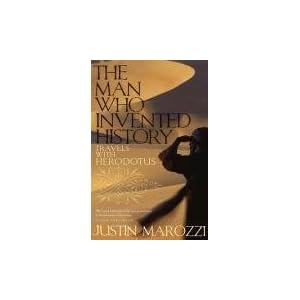
Man who invented history: Travels with Herodotus /Justin Marozzi .John Murray

“The poetry of history does not consist of imagination roaming at large , but of imagination pursuing the fact and fastening upon it……The dead were and are not.Their place knows them no more, and is ours today.Yet they were once real as we , and we shall tomorrow be shadows like them…” G M Trevelyan ,Autobiography and Other Essays.


You are greeted by the words above as you open the book .
The Man Who Invented History: Travels with HerodotusJustin Marozzi started reading history when there was nothing else left for him to study. Years later when he picked up the “Histories”, curious to read a man whose name had a forbidden ring to it ……he was instantly hooked. The author writes about his travels through Egypt, Turkey. Iraq ,Greece in an attempt to follow the Herodotean trail. The introductory chapter is about the Histories and more about the author’s fascination with Herodotus the man ,the travel writer the anthropologist, political theorist, foreign correspondent and historian. Herodotus invented the West which was conceived at Marathon and saw the light of the day with the Persian defeat in the battle of Platae. Marozzi describes him as the literary midwife .

The author begins his voyage with Bodrum the hometown of Herodotus. Modern Bodrum a modern resort town is more European than Greek. In Bodrum the author visits the famous site of the Mausoleum of Halicarnassus .The British archaeologist Charles Newton was instrumental in discovering the remains of the remarkable building and then transporting back the treasures to British Museum. The author comments “The British have form when it comes to digging up ruins all over the world and then taking the best pieces back to Britain”.

Marozzi moves between the past and present while writing about his travels through the different cities. He writes about the various contemporary political and social conflicts existing amongst these nations and countries like America and other neighbouring states . The grim situation in War torn Iraq, the centrality of the orthodox Church in Greek life, the illegal homosexual practices in Siwa, the frequent hymen repair jobs done in Egypt - the book is replete with engaging stories and descriptions that keep the readers interests alive throughout the book.

I personally enjoyed his descriptions of the past and his references to the Histories. Read this for example on “a morbid custom at plutocratic Egyptian dinners . When the rich give a party and the meal is finished a man carries round amongst the guests a wooden image of a corpse in a coffin ,…. he shows it to each guest in turn and says look upon this body as you drink and enjoy yourself for you will be just like it when you are dead”
An enjoyable read.

ref:
http://www.amazon.co.uk/The-Man-Who-Invented-History/dp/0719567114


Friday, March 9, 2012

Sankhini by Sangeeta Bandyopadhyay


Meeting a favourite writer can be exhilarating. I met two young leading Bengali writers within a week. Sangeeta Bandyopadhyay is one of the most talented original writers to  have emerged in the Bengali literary scene in recent times.  Her personal life is as romantic as her stories. Sangeeta lost her parents at a tender age and was brought up by her maternal uncle. Her first prose writing and her first novel “Sankhini” was written in self-imposed exile. She lived a solitary life in Santiniketan for a year doing nothing but writing and her first novel took shape in the form of Sankhini. Those who have read Sankhini will know how powerful, frank and open her writing is. It had created a huge stir when it was being published as a serialised novel in the Bengali magazine Desh .

There are autobiographical traces in Sankhini. The leading protagonist is a hugely exploited and betrayed woman who is at the same time a victim of her own sexual passions. The double life of men in her life who she thinks love her completely only to discover that they have their own parallel lives and never really belong to her wholly, tears her apart. It is a poignant tale and very much a woman’s tale. How many times have women been victim of such circumstances, every woman probably has a similar story to narrate. Cheated by husbands, lovers, and partners – women are duped again and again. Sankhini brings out the pain of the betrayed woman. It also explores boldly the theme of sexuality from the female perspective. Rarely do we come across women handling such themes so freely. I asked the writer whether the theme evolved spontaneously or was it a deliberately thought out narrative. She said it was a conscious decision. I felt the sexual theme is only one of the vehicles to explore the deep down pain which engulfs a woman’s soul eternally.

Sangeeta’s writings are being translated and hopefully her writings will touch many more lives.

Wednesday, January 25, 2012

Human Traces by Sebastian Faulks , Vintage International Edition, 656p


Sebastian Faulks was the literary editor of The Independent. Human traces was published in 2005  and it took Faulks five long years to complete the story.  Though he is more known for his book Birdsong which was made into a film, Human Traces is  also an interesting book  about consciousness and   the human mind.  The Tavistock Clinic in association with the University of East London awarded him an honorary doctorate for his contribution to the understanding of psychiatry in Human Traces.

Set in the late nineteenth century the story is about two young men who become friends and embark on a joint partnership to unravel the world of psychiatry. Jacques Rebiere  son of a forester lives in rural France and grows up to study  medicine in Paris .His brother Olivier is mentally challenged  and lives in a world of  his own. Jacques is determined to help his brother . Thomas Midwinter lives in England and is resigned to study medicine as per his father’s wishes . At the age of twenty the two men meet at a French sea side resort and become friends and partners on a lifelong path of scientific study and discovery. The two men  become pioneers in the nascent field of psychiatry.

The story revolves around the  lives of  the two  men . Sonia is Thomas’s sister who comes to live with her parents  after her husband  releases her from a loveless marriage but only after  he signs a lucrative  deal with Sonia’s father.  Jacques falls in love with  Sonia and marries her. Jacques and Thomas start working together . They face serious professional conflicts  which threaten to destroy their partnership.  The book captures details of the conditions of the asylums and the suffering of the patients in those times.  Psychiatry is a specialised discipline and generally people tend to ignore issues related to mental health problems unless they personally face such matters directly or indirectly. It is not easy to come across good psychiatrists in the same fashion that one might come across cardiologists or gynaecologists in cities infested with doctors of all shapes and kinds.

 I feel it requires some courage to write a story around such a complex theme. Around the central theme the story also talks about relationships – both Thomas and Jacques have very strong, supportive partners.  Jacques’ love for his brother, Thomas’ love for his sister and Sonia’s love for her brother -every relationship is beautifully built into the theme . A lengthy and a leisurely read , I found it quite easy to read Faulks since this was the first time I was reading  Faulks.

Friday, December 23, 2011

Graphic Guides

Wittgenstein: A Graphic Guide - Front Cover
I have discovered a quick and interesting way of upgrading my knowledge. I have started reading Graphic guides . My library was already overflowing with graphic novels and now come the graphic guides. Graphic novels are very popular with book thieves. My friend in Pune is losing graphic books regularly from her library collection. I have realised that graphic works can be very addictive for any age group of readers. My initial curiosity is turning into active scouting for the right content in the graphic form. The Introducing series of graphic guides published in the UK by Icon books Ltd can be sourced in India through Penguin Books. I am grateful to Penguin India for pricing the books sensibly .The books are in the range of 200 odd pages ,easy to hold and carry and the content is delightful . Capturing highlights and salient points of the topic the language is compact . I was able to complete one book while I was travelling on a very hectic schedule. And I am not a very fast reader . The illustrations are wonderful to look at and enhances your engagement with the theme.

Take for example the book “ Introducing : Wittgenstein : a graphic guide”. The book opens with an illustration of the palatial house of the Wittgensteins and details about his birth and parents. I found it easy to put the character into context. If this can happen to an adult reader like me I am sure this will definitely have a much stronger connect with young minds .One page captures an important phase at Trinity college with few sentences spoken by G.E Moore, Russell and Wittgenstein and three portraits of these men.” Wittgenstein always looks so puzzled…” .” Do you think I am an idiot” .“Why do you ask” . “Because if I am I’ll become an astronaut. But if I am not I will become a philosopher’

The format , I feel is excellent for new age readers who lack the time and mental training to delve into complex theories and detailed discussions on topics of wider interest. After the childhood obsession with various comic characters like phantom , tarzan , batul ,hada-bhoda I am seriously rediscovering the pleasures of reading graphic books. I also feel that it is a nice way of relaxing by admiring the sketches and possibly gaining some new knowledge as a spinoff.


Further reading


http://www.introducingbooks.com/book/group/Graphic

http://en.wikipedia.org/wiki/Graphic_novel


Thursday, November 17, 2011

Medicine's Strangest Cases (Strangest series) [Paperback],published by Portico ,315p.This edition published in 2009


Medicine's Strangest Cases (Strangest series) The book contains over 100 anecdotes from over five centuries of medical history. This collection of true tales ranges from the painful to the hilarious. We were brought up in an era when doctors were regarded as God in most Indian homes. Patients and their families never thought of questioning the doctor’s judgement at any point of time. Times have changed and the patient-doctor relationship is full of suspicion and mistrust nowadays. Almost two decades ago a young doctor who was going to the UK to complete his MRCP degree had remarked that doctors should be treated like any other professionals .They had to deliver against payment and that is where the transaction ended. I had found the logic contrary to my understanding of the noble mission of medical profession. Michael O’Donnell’s book portrays the profession from a wide range of angles. The stories are strikingly refreshing written in a concise manner in two to four pages each .The headings are imaginative and sometimes quite    humorous.

Followed by a brief introduction the book opens with a chapter called “The case of the vanishing father figure” where O’Donnell talks about Hippocrates and the Hippocratic Oath. In 1973 the science writer Dr Robert Reid wrote “It takes little consideration of the Hippocratic oath to conclude that it is a bigoted and dangerous document. It embraces hardline trade union practices…… As well as encouraging nepotistic incompetent hierarchies, it hands out totally ambiguous ethical advice.” O’Donnell writes “ One dangerous effect of the Hippocratic inheritance is the way  it is used by those who think that because they have acquired a medical degree, a divine light sparkles somewhere about their person”. I was pretty amused reading this statement but I must say the doctor is not alone guilty .Often divinity is bestowed upon them by well meaning patients and their families.
Trust me I ‘m a doctor recounts the story of Alexander the Great and the young doctor Philip the Acarnanian .Alexander was struck down  by a debilitating disease during his sojourn in Asia Minor . When the king’s physicians refused to treat him Philip agreed to try his skills. In spite of receiving a warning that Philip might poison him Alexander went ahead and swallowed the potion that Philip gave him. He recovered to win the battle against Darius.
In The Surgical Triple Whammy the author narrates the funny and sad story of the surgical speedstar Robert Liston a daring and successful Scottish surgeon who was known for his operating speed .Before the coming of anaesthetics the most admired of a surgeon’s skills was his operating speed. Sometimes his speed had “side-effects”. Once while amputing a patient’s leg in his standard two and a half minutes time his flashing knife removed the poor man’s testicles and on another occasion he inadvertently removed the fingers of his young assistant.
Large fees and how to get them is about doctors attempt to balance the demands of Hippocrates and Mammon. Faddy about his Food  tells the story of a three year old Spanish child who refused to eat and was taken to various doctors  by the anxious mother .The child thereafter  underwent a stomach operation which revealed he had swallowed 30 pebbles, two collar studs, two  buttons, two coins ,one screw and two plastic gambling chips.

The tales are extremely well chosen and is eminently suitable for lay readers. An excellent read for information, leisure and entertainment. Michael O’Donnell was a practising doctor, was editor of World Medicine and wrote a weekly column for BMJ.

The book can be ordered directly from www.anovabooks.com .Other topics under the strangest series – boxing,golf,sailing,tennis,television,scientific inventions political characters etc.

Sunday, November 6, 2011

Arthur and George ,Julian Barnes. Jonathan Cape

Julian Barnes finally won the Booker this year for his novel "The Sense of an Ending" after being nominated several times .The chair of this year's judges, former MI5 director general Stella Rimington, said the winning title had "the markings of a classic of English Literature. It is exquisitely written, subtly plotted and reveals new depths with each reading." I have read one book by Barnes and I have been captivated by his storytelling skills. Arthur and George was nominated for the Booker in 2005 but missed the trophy. After reading Arthur and George I had wondered how such a well constructed novel could fail to impress the judges. A&G will definitely figure in my list of all time favourites.


Arthur and George is the story of two lives Arthur Conan Doyle and a provincial half Indian solicitor George Edalji and the convergence of these two lives at one point. George is wrongly convicted by the police for killing of horses at Wyrley .George approaches Sir Arthur to help him fight his case which finally leads to George’s vindication.

The story is told mainly from two perspectives that of Arthur and George with some characters coming in between. I found the section and sub-section headings interesting. There are four main sections –Beginnings, Beginning with an Ending, Ending with a Beginning and Endings. The sections have sub-sections which simply alternate between Arthur, George, Arthur, George and sometimes George and Arthur, George, Campbell, George and Arthur. It is a mystery and the narrative keeps you involved throughout.

But Arthur and George is not just a crime story .Set against Edwardian background it is about Christianity, religion, racial discrimination, justice, love and society in general.

“The general opinion is that cities are violent, overcrowded places, while the countryside is calm and peaceable. His own experience is contrary: the country is turbulent and primitive, while the city is where life becomes orderly and modern.” I found a resonance in similar thoughts shared by a friend of mine who had been posted in a rural institute sometime back.

The discussions around race and religion -where George says “There were teasings and jokes. I am not so naïve as to be unaware that some people look at me differently. But I am a lawyer …. What evidence do I have that anyone acted against me because of race prjudice? …. What concerned me about more about the police was their lack of competence” and Sir Arthur comments “ The truths of one’s religion and the truths of one’s religion do not always lie in the same valley”- are insightful.The book at times had reminded me of Harper Lee’s classic novel.

The book is also about Sir Arthur’s life, his longstanding relationship with Jean, his work, his psychic and spiritual quests, his experiments with séances, his travels around the world.Sir Arthur's fans will definitely enjoy reading about the life and times of the famous man who still remains a popular household name across the world.
 Arthur and George is also a highly readable book because of the language which is simple and classic.The  360 page book is available in both hardback and paperback. I will definitely recommmend it as a brilliant piece of writing.

Ref:

http://www.guardian.co.uk/books/2011/oct/18/booker-prize-julian-barnes-wins

Saturday, October 8, 2011

Gilgamesh : A new English Version by Stephen Mitchell, Profile Books,First South Asian Edition Distributed by Viva Books 2006, Rs 325/-


“Who is like Gilgamesh? What other king
Has inspired such awe? Who else can say,
I alone rule, supreme among mankind?
The goddess Aruru, mother of creation
Had designed his body, had made him the strongest
Of men – huge, handsome, radiant, perfect.”


Gilgamesh , the oldest story on earth was written ,in ancient Mesopotamia in second millennium BC and predates the Iliad by at least thousand years. Its hero Gilgamesh was a historical king of the city Uruk (modern Iraq) and had an intimate friend Enkidu.Enkidu was a naked, wild man who was civilized through the erotic arts of the temple priestess Shamhat .With Enkidu Gilgamesh battles many monsters and when he dies he is inconsolable and sets out in search of someone who can tell him how to escape death. A brilliant tale of self-discovery Gilgamesh has been compared to the great epics but was lost to civilization for over two thousand years. The eleven clay tablets in which the story was inscribed in cuneiform was discovered in 1850 in the ruins of Nineveh. The great poet Rilke wrote in 1916 “Gilgamesh is stupendous” .He considered it to be a masterpiece in world literature.


Mitchell’s translation is superb and easy to read

“Humans are born, they live .then they die
------------------------
But until the end comes enjoy your life,
Spend it in happiness, not despair'"


“…….Suddenly ,savagely death
Destroys us, all of us, old or young
And yet we build house, make contacts, brothers
Divide their inheritance, conflicts occur
As though this human life lasted forever”


Gilgamesh’s despair after the death of Enkidu and his travails have been likened to Buddha’s renunciation and search for truth. The poetry is haunting and the feelings expressed by the poet are eternal.

"I cannot bear what happened to my friend.......
My beloved friend has turned into clay----

And won't I too lie down in the dirt
like him and never rise again"

 Mitchell writes a detailed and fascinating introduction to this composition where he describes the historical and cultural context of this epic. The story of the discovery and decipherment of the clay tablets is itself a great tale. A young English traveller Austen Henry Layard found tens of thousands of clay tablets buried in what was left of the library of the last great Assyrian king Ashurbanipal. Twenty five thousand of these treasures were taken away to England .In 1872 George Smith a curator in the British Museum first realized that a great story was written on the tablets. Probably such discoveries reflected the brighter side of imperialism and redeemed to an extent the various looting expeditions of the imperialists.


Friday, October 7, 2011

The Unbearable lightness of being/Milan Kundera, Translated from the Czech by Michael Henry Heim ,Faber and Faber,2004


The cover description says it is a story of irreconcilable love and infidelities. I picked up this book because I wanted to read Kundera. I wanted to read Kundera for a while but kept on delaying because I have heard all along that he was a cerebral writer and was not easy to read. The final push came from my friend who described him as a simple yet complex writer. According to my friend you can dwell on a sentence or a phrase from Kundera’s works for hours just to get a sense of what the author was trying to say. I was interested. Kundera did not disappoint me. He was not too intimidating either. The book is about relationships and the essential polygamous nature of man-woman relationships. While reading the book one wonders whether monogamy is a myth that society carefully nurtures. The story revolves around Tomas, Tereza, Sabina, Franz and others. The book begins by challenging the “mad myth of eternal return” which Nietzsche called the heaviest of burdens. “What then shall we choose weight or lightness?” Questions are raised on love, betrayal, sexuality, repression, freedom of speech etc.


Tomas a surgeon who has had over 200 women (erotic friendships) in a span of twenty five years is forced to leave his profession on account of writing a critical letter to the editor of a newspaper condemning the communists. Sabina is a woman who thrives on the concept of betrayal .She abandons Franz who leaves his wife of twenty years to be with her. Franz dies while travelling abroad with his mistress and in his death his wife finally claims him as her own. Tereza is torn between her love for Tomas and the anxiety over his constant infidelities which tear her apart. Tomas realises he loves Tereza but thinks love and sexuality cannot be equated. Tereza’s dog Karenin plays a key role in the novel and is instrumental in bringing Tereza and Tomas together in the end.


The book is strewn with sentences like these

“We can never know what to want because, living only one life, we can neither compare it with our previous lives nor perfect it in our lives to come”..

” And what can life be worth if the first rehearsal for life is life itself?”

“In a society run by terror, no statements whatsoever can be taken seriously. They are all forced ..”


I wonder if the translation has been able to capture the spirit of the original of such a philosophical novel. The 300 page book should be read slowly and in leisure.

Follow the link below to read more about the story

http://en.wikipedia.org/wiki/The_Unbearable_Lightness_of_Being