Tuesday, April 17, 2012

Two books by J M Coetzee ,Vintage


Youth 

Youth is a story about a young man who leaves his home in South Africa and comes to England to study .The protagonist dreams of becoming an artist but gets entangled into living a solid life – regular  job , assignments , home .Solidity is his Achilles Heels. He initially joins IBM. But IBM he can swear, is killing him, turning him into a zombie. He is in the world of business and in the world of business one does not need to be polite. He quits  IBM . Works for another computer company which allows some scope for creativity and innovation .He discovers something outside American culture which was their staple food in South Africa. I was pleasantly surprised to discover references to India and Indian culture . He watches and experiences the magic of  Ray’s Apu  trilogy  – the music grips him. He explores further and is enchanted by Ustad Vilayat khan’s music.
He makes Indian friends. He dines with a South Indian couple .Meets Ganapathy the computer wizard who is too lazy to cook and eats bananas to survive .
There is lot of confusion about love ,sex ,life .The young man finds no real passion for any woman and gets involved in casual relationships  which frustrate him. “ If he is a mystery to himself how can he be anything but a mystery to others. “
Youth is part autobiographical and recounts the author's early days in England.

Life and times of Michael K 

Set in South Africa torn  by civil war  this  is the  story of Michael K a man born with a hare lip who is an object of pity and ridicule. Michael tries to take his ailing mother away from the city to the countryside where she was born . She dies on the way and Michael is left all alone in the world. She was the only person he loved in this world and the narrative captures beautiful moments of his many valiant efforts to make his mother happy. For example he slogs hard to make a cart which  he uses to take his sick mother around and to travel  from one place to another. After his mother’s death Michael is on his own and wants nothing from anyone but society will not allow him to do so. He is arrested several times and placed in camps , confinements but escapes to live life on his own terms. No papers, no  money, no family , no friends, no sense of who you are- the obscurest of the obscure – so obscure as to be a prodigy-that is what he is. Yet  he survives the war and lives in a world of his own . He is a simpleton but fiercely defends his independence . “People like Michaels are in touch with things you and I don’t understand”
The book won the Booker Prize in 1983.


Coetzee tries to explore the inner world of man in both the works. The language is simple and lucid .He won the Nobel Prize in 2003 and the Booker twice .

Ref:


Sunday, April 8, 2012

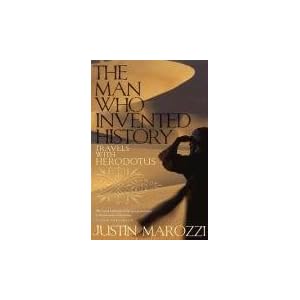
Man who invented history: Travels with Herodotus /Justin Marozzi .John Murray

“The poetry of history does not consist of imagination roaming at large , but of imagination pursuing the fact and fastening upon it……The dead were and are not.Their place knows them no more, and is ours today.Yet they were once real as we , and we shall tomorrow be shadows like them…” G M Trevelyan ,Autobiography and Other Essays.


You are greeted by the words above as you open the book .
The Man Who Invented History: Travels with HerodotusJustin Marozzi started reading history when there was nothing else left for him to study. Years later when he picked up the “Histories”, curious to read a man whose name had a forbidden ring to it ……he was instantly hooked. The author writes about his travels through Egypt, Turkey. Iraq ,Greece in an attempt to follow the Herodotean trail. The introductory chapter is about the Histories and more about the author’s fascination with Herodotus the man ,the travel writer the anthropologist, political theorist, foreign correspondent and historian. Herodotus invented the West which was conceived at Marathon and saw the light of the day with the Persian defeat in the battle of Platae. Marozzi describes him as the literary midwife .

The author begins his voyage with Bodrum the hometown of Herodotus. Modern Bodrum a modern resort town is more European than Greek. In Bodrum the author visits the famous site of the Mausoleum of Halicarnassus .The British archaeologist Charles Newton was instrumental in discovering the remains of the remarkable building and then transporting back the treasures to British Museum. The author comments “The British have form when it comes to digging up ruins all over the world and then taking the best pieces back to Britain”.

Marozzi moves between the past and present while writing about his travels through the different cities. He writes about the various contemporary political and social conflicts existing amongst these nations and countries like America and other neighbouring states . The grim situation in War torn Iraq, the centrality of the orthodox Church in Greek life, the illegal homosexual practices in Siwa, the frequent hymen repair jobs done in Egypt - the book is replete with engaging stories and descriptions that keep the readers interests alive throughout the book.

I personally enjoyed his descriptions of the past and his references to the Histories. Read this for example on “a morbid custom at plutocratic Egyptian dinners . When the rich give a party and the meal is finished a man carries round amongst the guests a wooden image of a corpse in a coffin ,…. he shows it to each guest in turn and says look upon this body as you drink and enjoy yourself for you will be just like it when you are dead”
An enjoyable read.

ref:
http://www.amazon.co.uk/The-Man-Who-Invented-History/dp/0719567114


Friday, March 9, 2012

Sankhini by Sangeeta Bandyopadhyay


Meeting a favourite writer can be exhilarating. I met two young leading Bengali writers within a week. Sangeeta Bandyopadhyay is one of the most talented original writers to  have emerged in the Bengali literary scene in recent times.  Her personal life is as romantic as her stories. Sangeeta lost her parents at a tender age and was brought up by her maternal uncle. Her first prose writing and her first novel “Sankhini” was written in self-imposed exile. She lived a solitary life in Santiniketan for a year doing nothing but writing and her first novel took shape in the form of Sankhini. Those who have read Sankhini will know how powerful, frank and open her writing is. It had created a huge stir when it was being published as a serialised novel in the Bengali magazine Desh .

There are autobiographical traces in Sankhini. The leading protagonist is a hugely exploited and betrayed woman who is at the same time a victim of her own sexual passions. The double life of men in her life who she thinks love her completely only to discover that they have their own parallel lives and never really belong to her wholly, tears her apart. It is a poignant tale and very much a woman’s tale. How many times have women been victim of such circumstances, every woman probably has a similar story to narrate. Cheated by husbands, lovers, and partners – women are duped again and again. Sankhini brings out the pain of the betrayed woman. It also explores boldly the theme of sexuality from the female perspective. Rarely do we come across women handling such themes so freely. I asked the writer whether the theme evolved spontaneously or was it a deliberately thought out narrative. She said it was a conscious decision. I felt the sexual theme is only one of the vehicles to explore the deep down pain which engulfs a woman’s soul eternally.

Sangeeta’s writings are being translated and hopefully her writings will touch many more lives.

Wednesday, January 25, 2012

Human Traces by Sebastian Faulks , Vintage International Edition, 656p


Sebastian Faulks was the literary editor of The Independent. Human traces was published in 2005  and it took Faulks five long years to complete the story.  Though he is more known for his book Birdsong which was made into a film, Human Traces is  also an interesting book  about consciousness and   the human mind.  The Tavistock Clinic in association with the University of East London awarded him an honorary doctorate for his contribution to the understanding of psychiatry in Human Traces.

Set in the late nineteenth century the story is about two young men who become friends and embark on a joint partnership to unravel the world of psychiatry. Jacques Rebiere  son of a forester lives in rural France and grows up to study  medicine in Paris .His brother Olivier is mentally challenged  and lives in a world of  his own. Jacques is determined to help his brother . Thomas Midwinter lives in England and is resigned to study medicine as per his father’s wishes . At the age of twenty the two men meet at a French sea side resort and become friends and partners on a lifelong path of scientific study and discovery. The two men  become pioneers in the nascent field of psychiatry.

The story revolves around the  lives of  the two  men . Sonia is Thomas’s sister who comes to live with her parents  after her husband  releases her from a loveless marriage but only after  he signs a lucrative  deal with Sonia’s father.  Jacques falls in love with  Sonia and marries her. Jacques and Thomas start working together . They face serious professional conflicts  which threaten to destroy their partnership.  The book captures details of the conditions of the asylums and the suffering of the patients in those times.  Psychiatry is a specialised discipline and generally people tend to ignore issues related to mental health problems unless they personally face such matters directly or indirectly. It is not easy to come across good psychiatrists in the same fashion that one might come across cardiologists or gynaecologists in cities infested with doctors of all shapes and kinds.

 I feel it requires some courage to write a story around such a complex theme. Around the central theme the story also talks about relationships – both Thomas and Jacques have very strong, supportive partners.  Jacques’ love for his brother, Thomas’ love for his sister and Sonia’s love for her brother -every relationship is beautifully built into the theme . A lengthy and a leisurely read , I found it quite easy to read Faulks since this was the first time I was reading  Faulks.

Friday, December 23, 2011

Graphic Guides

Wittgenstein: A Graphic Guide - Front Cover
I have discovered a quick and interesting way of upgrading my knowledge. I have started reading Graphic guides . My library was already overflowing with graphic novels and now come the graphic guides. Graphic novels are very popular with book thieves. My friend in Pune is losing graphic books regularly from her library collection. I have realised that graphic works can be very addictive for any age group of readers. My initial curiosity is turning into active scouting for the right content in the graphic form. The Introducing series of graphic guides published in the UK by Icon books Ltd can be sourced in India through Penguin Books. I am grateful to Penguin India for pricing the books sensibly .The books are in the range of 200 odd pages ,easy to hold and carry and the content is delightful . Capturing highlights and salient points of the topic the language is compact . I was able to complete one book while I was travelling on a very hectic schedule. And I am not a very fast reader . The illustrations are wonderful to look at and enhances your engagement with the theme.

Take for example the book “ Introducing : Wittgenstein : a graphic guide”. The book opens with an illustration of the palatial house of the Wittgensteins and details about his birth and parents. I found it easy to put the character into context. If this can happen to an adult reader like me I am sure this will definitely have a much stronger connect with young minds .One page captures an important phase at Trinity college with few sentences spoken by G.E Moore, Russell and Wittgenstein and three portraits of these men.” Wittgenstein always looks so puzzled…” .” Do you think I am an idiot” .“Why do you ask” . “Because if I am I’ll become an astronaut. But if I am not I will become a philosopher’

The format , I feel is excellent for new age readers who lack the time and mental training to delve into complex theories and detailed discussions on topics of wider interest. After the childhood obsession with various comic characters like phantom , tarzan , batul ,hada-bhoda I am seriously rediscovering the pleasures of reading graphic books. I also feel that it is a nice way of relaxing by admiring the sketches and possibly gaining some new knowledge as a spinoff.


Further reading


http://www.introducingbooks.com/book/group/Graphic

http://en.wikipedia.org/wiki/Graphic_novel


Thursday, November 17, 2011

Medicine's Strangest Cases (Strangest series) [Paperback],published by Portico ,315p.This edition published in 2009


Medicine's Strangest Cases (Strangest series) The book contains over 100 anecdotes from over five centuries of medical history. This collection of true tales ranges from the painful to the hilarious. We were brought up in an era when doctors were regarded as God in most Indian homes. Patients and their families never thought of questioning the doctor’s judgement at any point of time. Times have changed and the patient-doctor relationship is full of suspicion and mistrust nowadays. Almost two decades ago a young doctor who was going to the UK to complete his MRCP degree had remarked that doctors should be treated like any other professionals .They had to deliver against payment and that is where the transaction ended. I had found the logic contrary to my understanding of the noble mission of medical profession. Michael O’Donnell’s book portrays the profession from a wide range of angles. The stories are strikingly refreshing written in a concise manner in two to four pages each .The headings are imaginative and sometimes quite    humorous.

Followed by a brief introduction the book opens with a chapter called “The case of the vanishing father figure” where O’Donnell talks about Hippocrates and the Hippocratic Oath. In 1973 the science writer Dr Robert Reid wrote “It takes little consideration of the Hippocratic oath to conclude that it is a bigoted and dangerous document. It embraces hardline trade union practices…… As well as encouraging nepotistic incompetent hierarchies, it hands out totally ambiguous ethical advice.” O’Donnell writes “ One dangerous effect of the Hippocratic inheritance is the way  it is used by those who think that because they have acquired a medical degree, a divine light sparkles somewhere about their person”. I was pretty amused reading this statement but I must say the doctor is not alone guilty .Often divinity is bestowed upon them by well meaning patients and their families.
Trust me I ‘m a doctor recounts the story of Alexander the Great and the young doctor Philip the Acarnanian .Alexander was struck down  by a debilitating disease during his sojourn in Asia Minor . When the king’s physicians refused to treat him Philip agreed to try his skills. In spite of receiving a warning that Philip might poison him Alexander went ahead and swallowed the potion that Philip gave him. He recovered to win the battle against Darius.
In The Surgical Triple Whammy the author narrates the funny and sad story of the surgical speedstar Robert Liston a daring and successful Scottish surgeon who was known for his operating speed .Before the coming of anaesthetics the most admired of a surgeon’s skills was his operating speed. Sometimes his speed had “side-effects”. Once while amputing a patient’s leg in his standard two and a half minutes time his flashing knife removed the poor man’s testicles and on another occasion he inadvertently removed the fingers of his young assistant.
Large fees and how to get them is about doctors attempt to balance the demands of Hippocrates and Mammon. Faddy about his Food  tells the story of a three year old Spanish child who refused to eat and was taken to various doctors  by the anxious mother .The child thereafter  underwent a stomach operation which revealed he had swallowed 30 pebbles, two collar studs, two  buttons, two coins ,one screw and two plastic gambling chips.

The tales are extremely well chosen and is eminently suitable for lay readers. An excellent read for information, leisure and entertainment. Michael O’Donnell was a practising doctor, was editor of World Medicine and wrote a weekly column for BMJ.

The book can be ordered directly from www.anovabooks.com .Other topics under the strangest series – boxing,golf,sailing,tennis,television,scientific inventions political characters etc.

Sunday, November 6, 2011

Arthur and George ,Julian Barnes. Jonathan Cape

Julian Barnes finally won the Booker this year for his novel "The Sense of an Ending" after being nominated several times .The chair of this year's judges, former MI5 director general Stella Rimington, said the winning title had "the markings of a classic of English Literature. It is exquisitely written, subtly plotted and reveals new depths with each reading." I have read one book by Barnes and I have been captivated by his storytelling skills. Arthur and George was nominated for the Booker in 2005 but missed the trophy. After reading Arthur and George I had wondered how such a well constructed novel could fail to impress the judges. A&G will definitely figure in my list of all time favourites.


Arthur and George is the story of two lives Arthur Conan Doyle and a provincial half Indian solicitor George Edalji and the convergence of these two lives at one point. George is wrongly convicted by the police for killing of horses at Wyrley .George approaches Sir Arthur to help him fight his case which finally leads to George’s vindication.

The story is told mainly from two perspectives that of Arthur and George with some characters coming in between. I found the section and sub-section headings interesting. There are four main sections –Beginnings, Beginning with an Ending, Ending with a Beginning and Endings. The sections have sub-sections which simply alternate between Arthur, George, Arthur, George and sometimes George and Arthur, George, Campbell, George and Arthur. It is a mystery and the narrative keeps you involved throughout.

But Arthur and George is not just a crime story .Set against Edwardian background it is about Christianity, religion, racial discrimination, justice, love and society in general.

“The general opinion is that cities are violent, overcrowded places, while the countryside is calm and peaceable. His own experience is contrary: the country is turbulent and primitive, while the city is where life becomes orderly and modern.” I found a resonance in similar thoughts shared by a friend of mine who had been posted in a rural institute sometime back.

The discussions around race and religion -where George says “There were teasings and jokes. I am not so naïve as to be unaware that some people look at me differently. But I am a lawyer …. What evidence do I have that anyone acted against me because of race prjudice? …. What concerned me about more about the police was their lack of competence” and Sir Arthur comments “ The truths of one’s religion and the truths of one’s religion do not always lie in the same valley”- are insightful.The book at times had reminded me of Harper Lee’s classic novel.

The book is also about Sir Arthur’s life, his longstanding relationship with Jean, his work, his psychic and spiritual quests, his experiments with séances, his travels around the world.Sir Arthur's fans will definitely enjoy reading about the life and times of the famous man who still remains a popular household name across the world.
 Arthur and George is also a highly readable book because of the language which is simple and classic.The  360 page book is available in both hardback and paperback. I will definitely recommmend it as a brilliant piece of writing.

Ref:

http://www.guardian.co.uk/books/2011/oct/18/booker-prize-julian-barnes-wins